CQC Key Lines of Enquiry (KLOEs) Explained: The Five Key Questions and What Inspectors Look For
With the CQC returning to Key Lines of Enquiry (KLOEs) in 2026, a lot of clinic owners are asking the same thing: what are the KLOEs, actually — and what will an inspector be looking for under each one? This guide breaks the framework down in plain English, using the CQC’s own published KLOEs, and shows how to turn each question into evidence you can put your hands on.
A quick note on scope: the CQC publishes slightly different KLOE sets for different sectors (adult social care, healthcare, primary care). The structure — the Five Key Questions and the lines of enquiry beneath them — is consistent across all of them. If you run a CQC-registered aesthetic or cosmetic clinic, the healthcare framework applies to you, but the principles below are universal.
New to the 2026 changes? Start with our overview of the 2026 CQC reform — what is changing and what is not, then use this guide to go deeper on the KLOEs themselves.
The foundation: the Five Key Questions
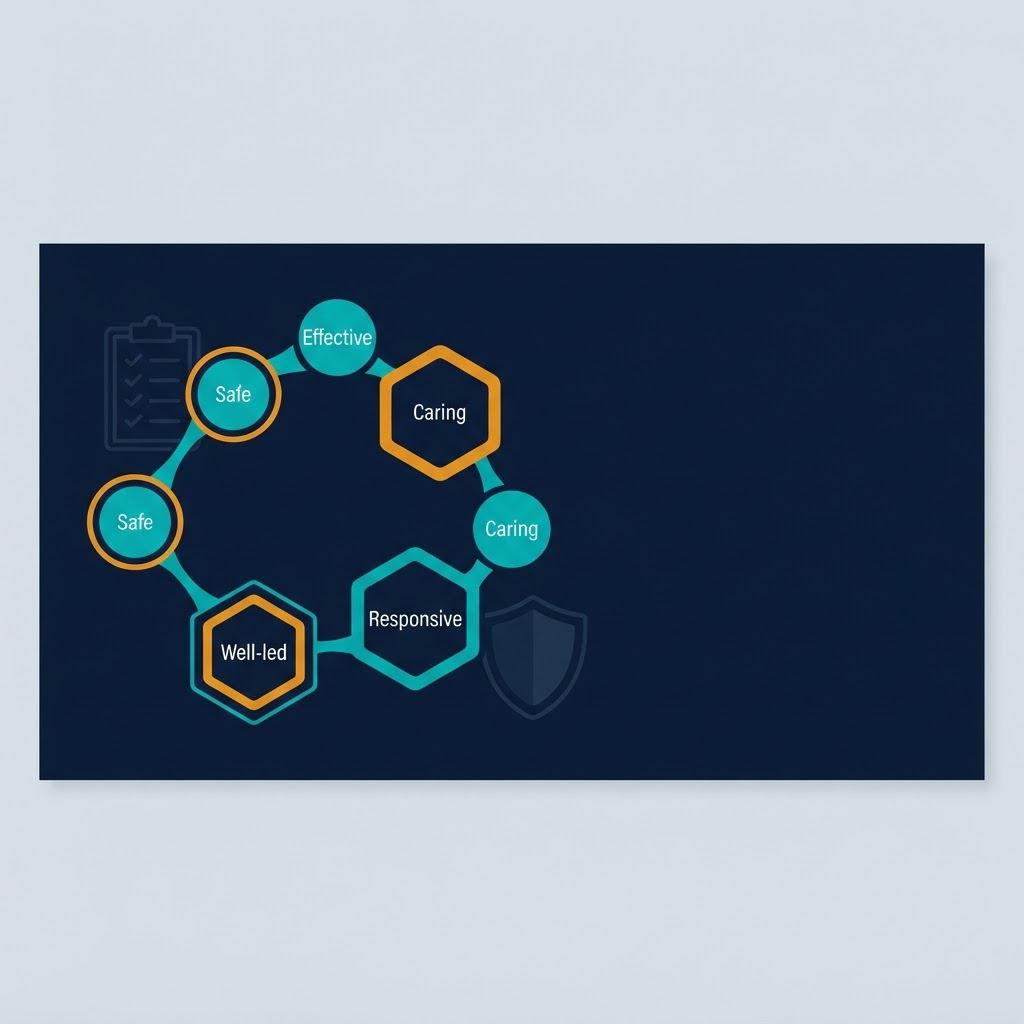
Every CQC assessment, in every sector, is built on the same five questions. An inspector is always asking whether your service is:
- Safe — are people protected from abuse and avoidable harm?
- Effective — does care, treatment and support achieve good outcomes and follow current evidence?
- Caring — do staff treat people with compassion, kindness, dignity and respect?
- Responsive — are services organised to meet people’s needs?
- Well-led — does leadership, governance and culture support high-quality, person-centred care?
The KLOEs sit underneath each of these questions. They are the structured sub-questions an inspector works through, and each KLOE has “prompts” — the specific things they will look at to answer it.
Safe — the KLOEs
The Safe question digs into how you prevent harm before it happens, and how you respond when something goes wrong. The lines of enquiry cover:
- How systems, processes and practices safeguard people from abuse.
- How risks to people are assessed, monitored and mitigated.
- Whether there are sufficient numbers of suitable, competent staff.
- How you ensure the proper and safe use of medicines.
- How well people are protected by the prevention and control of infection.
- Whether lessons are learned and improvements made when things go wrong.
What this looks like as evidence: risk assessments, an incident and near-miss log, safeguarding policy and training records, staff competency and recruitment checks, medicines management and drug-box reconciliation, IPC audits, and a demonstrable “you said, we did” trail after incidents.
Effective — the KLOEs
Effective is about outcomes and evidence-based practice. The lines of enquiry ask:
- Are needs assessed and care delivered in line with current legislation, standards and evidence-based guidance?
- Do staff have the skills, knowledge and experience to deliver effective care?
- How well do teams and services work together to deliver joined-up care?
- How are people supported to live healthier lives and access ongoing support?
- How is consent sought and documented in line with legislation?
What this looks like as evidence: clinical protocols mapped to recognised guidance, a training and competency matrix, revalidation and CPD records, and consent processes that stand up to the Montgomery standard.
Caring — the KLOEs
Caring is about how people experience your service on a human level. The lines of enquiry cover:
- Whether people are treated with kindness, respect and compassion, and given emotional support.
- How people are supported to express their views and be involved in decisions about their care.
- How privacy, dignity and independence are respected and promoted.
What this looks like as evidence: patient feedback, satisfaction data, complaints handled well, and clear processes for involving people in their own treatment decisions.
Responsive — the KLOEs
Responsive asks whether your service is built around the person, not the other way round. The lines of enquiry ask:
- How people receive personalised care responsive to their needs.
- How concerns and complaints are listened to and used to improve care.
What this looks like as evidence: a proper complaints register with root-cause and learning captured, accessible information for patients, and evidence that feedback actually changes how you work.
Well-led — the KLOEs
Well-led is where a lot of clinics lose marks — not because the care is poor, but because the governance behind it is not evidenced. The lines of enquiry cover:
- Whether there is a clear vision, credible strategy and positive culture.
- Whether the governance framework makes responsibilities clear and manages quality, risk and regulatory requirements.
- How the public, people using the service and staff are engaged and involved.
- How the service continuously learns, improves and innovates.
- How the service works in partnership with other agencies.
What this looks like as evidence: a Statement of Purpose, a live governance framework mapped to the regulations, team meeting and clinical governance records, a Freedom to Speak Up route, duty of candour records, and audits that feed into a visible improvement cycle.
The pattern behind every KLOE
Read across all five questions and one thing becomes obvious: the CQC is not asking whether you do these things — it is asking whether you can evidence that you do them, consistently, and that you act on what you find. A clinic can deliver excellent care and still struggle at inspection simply because the evidence is scattered across spreadsheets, inboxes and someone’s memory.
That is the gap INTENTIQ is built to close. Rather than assembling evidence in a panic before an inspection, the platform maps your day-to-day clinic activity against the framework as you go — audits, incidents, consent, training, complaints, governance and more — and surfaces a live readiness picture across all CQC regulations. It is designed to support your CQC readiness and help you evidence good governance, so that when an inspector works through the KLOEs, the answers are already there.
Bringing it together
The KLOEs are not a hurdle invented to catch you out. They are a structured way of asking the questions any well-run clinic should be able to answer about itself. Use them as a checklist: for each line of enquiry, ask “could I put my hand on the evidence for that in under a minute?” Where the answer is no, that is where to focus.
If you would like to see how your clinic maps against the Five Key Questions right now, we can walk you through a live readiness view in about 20 minutes. Call us on 0333 043 2226 or email info@intentiq.co.uk.
Run the clinic. See the risk. Evidence the quality.
This article is general guidance and is not a substitute for the CQC’s own published frameworks or professional regulatory advice. The Key Lines of Enquiry referenced are drawn from the CQC’s published KLOE, prompts and ratings characteristics documentation.