Batch traceability at the injection point: seven questions to ask your clinic software
If the MHRA recalls a batch tomorrow morning, how long would it take you to name every patient it went into — and the exact sites and units for each one?
For most aesthetic clinics the honest answer sits somewhere between “a couple of hours with the treatment diary” and “we would have to work it out from memory”. That gap is what this article is about, because it is the difference between recording batch numbers and actually having traceability.
“We record batch numbers” is not the same as traceability
Almost every clinic system on the market lets you write down a batch or lot number. The question inspectors and manufacturers eventually ask is narrower and harder: which vial went into which site, at what dose, in which patient?
Recording one batch number against a whole appointment cannot answer that. If a patient had two products in one session — a toxin in the upper face and a filler in the midface, which is an ordinary Tuesday in most clinics — a single batch field on the treatment record has already lost the detail. So has a stock module that knows a vial left the fridge but not where it ended up.
The test is not whether the software can store a batch number. It is whether the batch number is attached to the injection point rather than to the invoice.
What INTENTIQ records at every point on the map
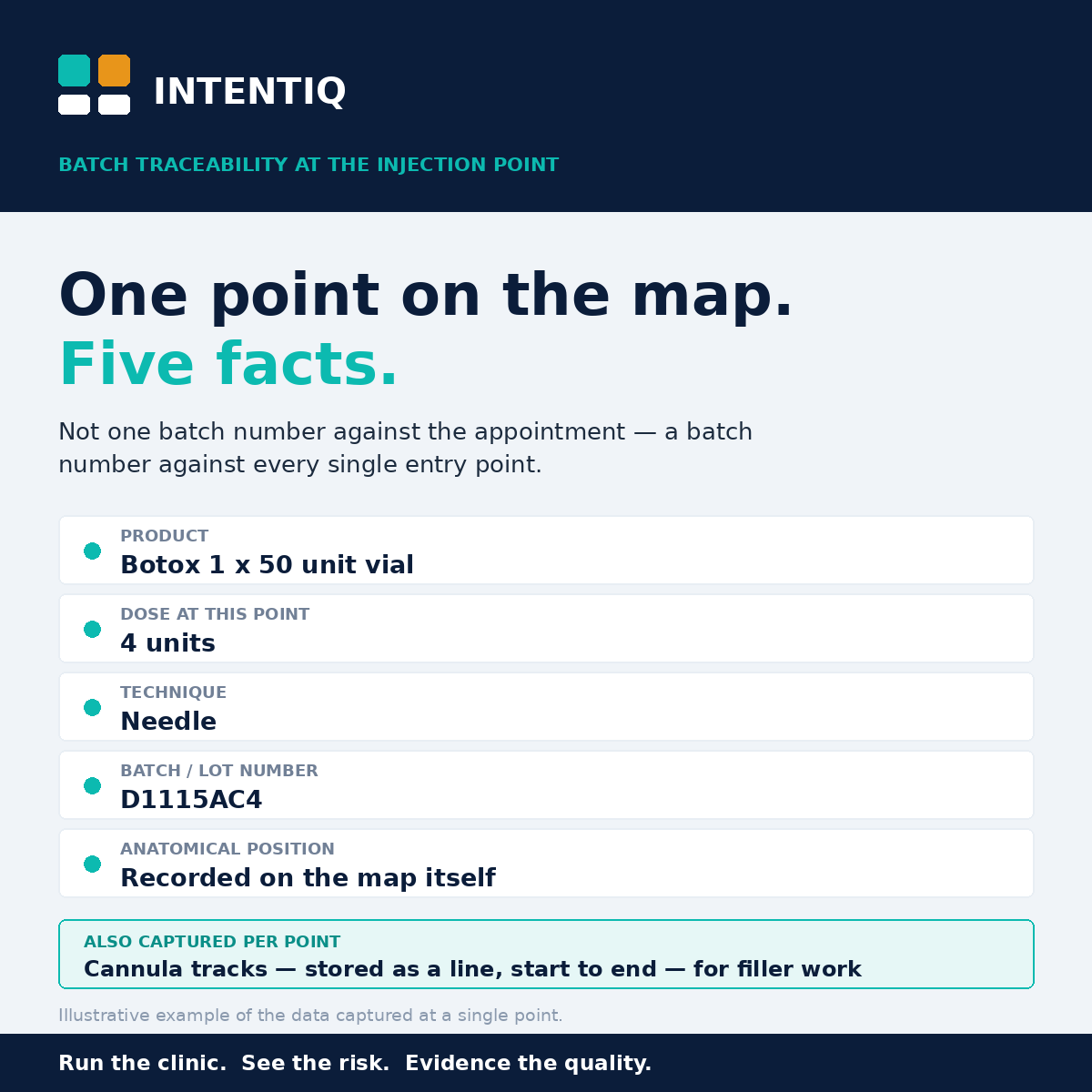
In INTENTIQ, the injection map is not a drawing with notes attached. It is structured clinical data. The clinician marks each entry point on the patient’s own photograph or a face diagram, and every individual point carries:
- the product used, by name
- the dose at that point — units or millilitres
- the technique, needle or cannula
- the batch or lot number for that specific product
- the anatomical position of the point itself
Because technique is captured properly, a cannula pass — used for filler work rather than toxin — is stored as a line with a start and an end rather than as a dot, which is what actually happened clinically. A live summary tallies total units, millilitres and entry points as the clinician works, and a single map can carry more than one product, each point attributed to its own batch.
That structure is what makes the recall question answerable in one query instead of an afternoon of cross-referencing. It is also what makes a complication review meaningful six months later: you can see the exact site, the exact dose and the exact vial, not a general note that the glabella was treated.
Notes that land on the same record
Traceability falls apart when the note lives somewhere else. In INTENTIQ, the clinical note sits on the same treatment record as the consent, the before and after photographs, the products used and the map itself.
Notes can be dictated. The clinician speaks the consultation and INTENTIQ structures it into the fields a compliant record needs — history, examination, treatment, plan, aftercare — using templates mapped to CQC Regulations 9, 12, 15 and 17. Crucially the AI drafts and the clinician signs: nothing enters the record without clinician approval, and the record keeps a full audit trail of who signed and when.
Products, batch numbers and injection sites link straight from the note, so traceability is a by-product of doing the treatment rather than a separate admin task someone has to remember.
Stock, expiry and the alert nobody wants to miss
The product register holds batch numbers, expiry dates and supplier detail, with RAG scoring that surfaces low stock and approaching expiry before either becomes a problem.
The part clinics tell us they value most is what happens when a national alert lands. MHRA and GOV.UK device safety alerts are pulled in automatically and checked against the products on your shelf, and each check is signed and timestamped. You find out whether an alert touches your clinic without reading every notice and hoping you remember what is in the fridge.
How to compare systems fairly
ANS and AESORI, Pabau, Faces, Aesthetic Record and Fresha are all credible products with real strengths, and several are strong on things INTENTIQ deliberately does differently. Rather than tell you what they do or do not do, here are the questions worth asking any system you are evaluating — including ours. Ask for a live demonstration rather than a feature list.
- Show me one injection point on a past treatment, and show me the batch number for that point — not for the appointment.
- Show me a treatment where two different products were used in one session, with each point attributed correctly.
- How is a cannula pass recorded differently from a needle injection?
- A batch is recalled this morning. Show me how I get the list of affected patients, sites and doses.
- Who signed this clinical note, when, and what did it say before it was edited?
- Where does the system tell me a product is approaching expiry, and who sees it?
- When an MHRA alert is published, what does the system do without anyone logging in?
If a system answers all seven cleanly, it is a serious contender. If any answer starts with “you could put that in the notes field”, that is your evidence gap.
The honest bit
No software guarantees CQC registration or a rating, and any vendor implying otherwise should worry you. What good software does is make the evidence exist as a by-product of clinical work, so it is there when someone asks. INTENTIQ is built to support CQC readiness and to help you evidence governance — the clinical judgement stays yours.
Want to see the injection map and the recall query on real data?
Or call 0333 043 2226
Run the clinic. See the risk. Evidence the quality.